
Raise your hand if chili crisp lives in your fridge as a permanent resident? (Raises hand – GUILTY.)
But with an active pitta constitution, I don’t reach for it all through the summer the same way I do in January. My body wants it less. It needs less heat. But that doesn’t mean that bright, punchy flavor isn’t supportive, even for little old firey me.
Enter this Ayurvedically-inspired, Crunchy Crackle Ghee – something between a chili crisp riff and a straight up medicinal drizzle to zhoosh up all of our meals.
If I’m honest, this experiment was highly influenced by one of my favorite cooks – Molly Baz – whose recipes I find to be beautiful, often cravable, but rarely wise for good digestion. (It’s not always about digestion, but often, frankly, it is!) She recently released a recipe for a pistachio crackle sauce that blooms chilis and garlic in olive oil, then adds parmesan, pistachios, lemon zest…sounds bomb. And like a gut bomb too.
Totally inspired and determined to have a version that wouldn’t make my digestion want to explode, I started working with my favorite oil – ghee. I chose a few ingredients that would be supportive for all constitutions, and much more friendly for us hottie pittas than chilis and pistachios. This was the completely undeniable result. I would call it crack sauce if I could.
Thanks for the poke, Molly. We owe ya!
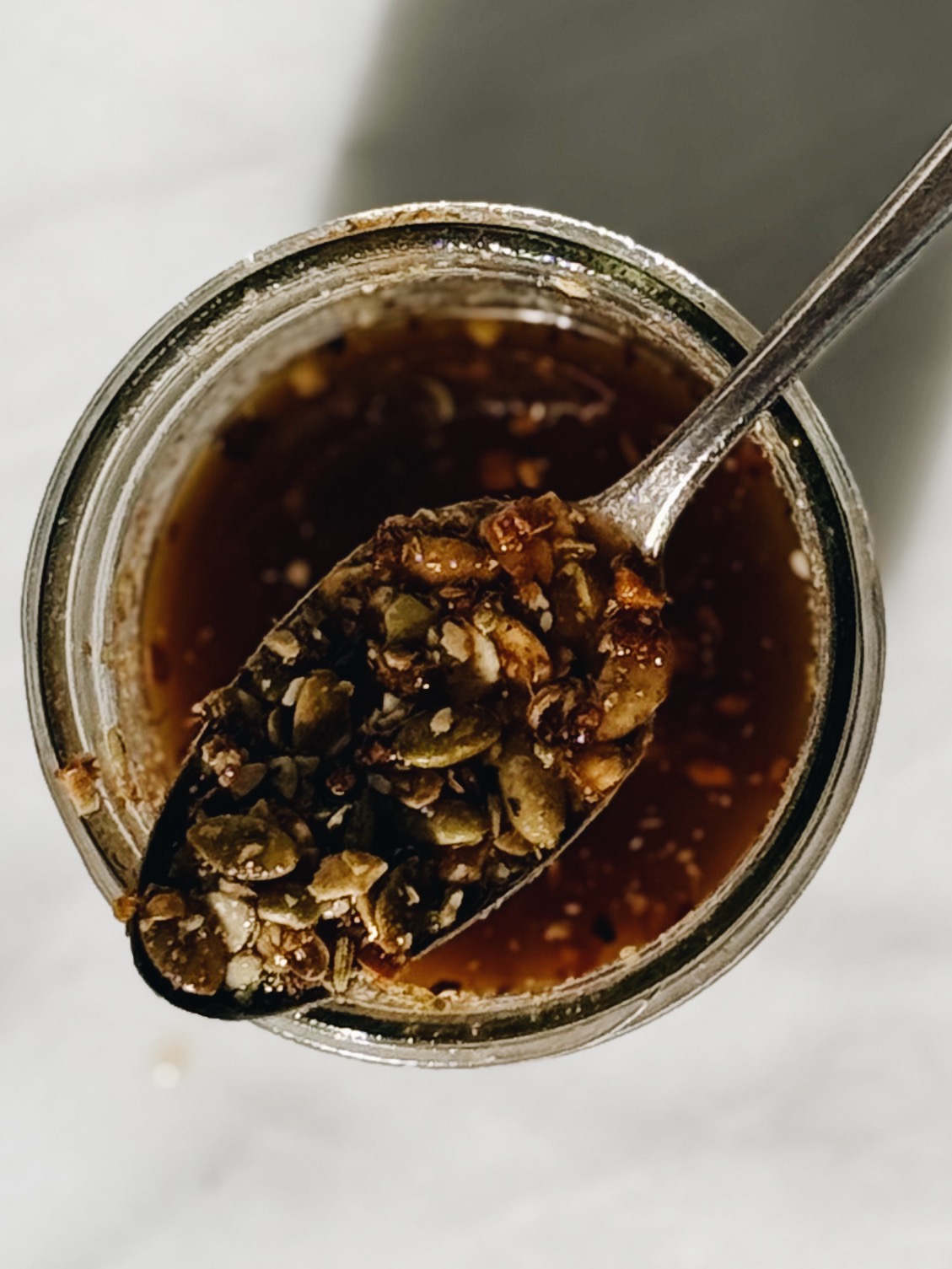
Every chili crisp recipe leans on a neutral high-smoke-point oil — that’s the engine of the format. The smoke point of an oil is the point at which the oil starts to denature and lose it’s nutritive benefits, and also the point at which it starts to off gas something called acrolein, an odorous volatile aldehyde responsible for the acrid, pungent smell and bitter taste of burnt food. Taking an oil past it’s smoke point also produces free radicals and polar compounds of aldehydes (or degrated fat molecules) that are near impossible for the body to digest. The thing about making something like chili crisp is that you’re basically going to take the oil right up to it’s smoke point (making it a kinda toxic but delicious food.) Unless, you use ghee. Ghee has an incredibly high smoke point – up to 480°F which is nearly 60°F over canola oils 400°F and olive oils 375°F. You’re going to really raise the temp when making this recipe, and we don’t want any of that gnarly stuff in our crackle sauce! Plus, it does such a beautiful job of blooming these spices and toasting these pumpkin seeds.
But ghee also digests differently than a neutral oil: it’s traditionally considered easy on agni (your digestive fire), which matters when you’re pouring a fat-forward condiment over food in the middle of summer, when digestion tends to run lighter anyway. Oil gets you the crackle. Ghee gets you the crackle and doesn’t sit like a brick afterward.
It’s also worth mentioning that ghee is one of the only oils around that doesn’t provoke oily pitta. Hotties win here.
This isn’t a “good for gut health” hand-wave — it’s specific. Ghee is one of the few fats Ayurveda treats as actively digestion-supportive rather than neutral. It lubricates without dulling agni, and it’s often used as a carrier — a way to help the qualities of other ingredients (here, chili, pumpkin seed, spices) move through the body more smoothly instead of sitting heavy. Chili flake itself stimulates agni or digestive fire directly — that’s the mechanism behind why spicy food can genuinely aid digestion in the right dose. The pumpkin seeds add a little bulk and a little fat and some crunch, which is what makes this condiment truly crack-like.
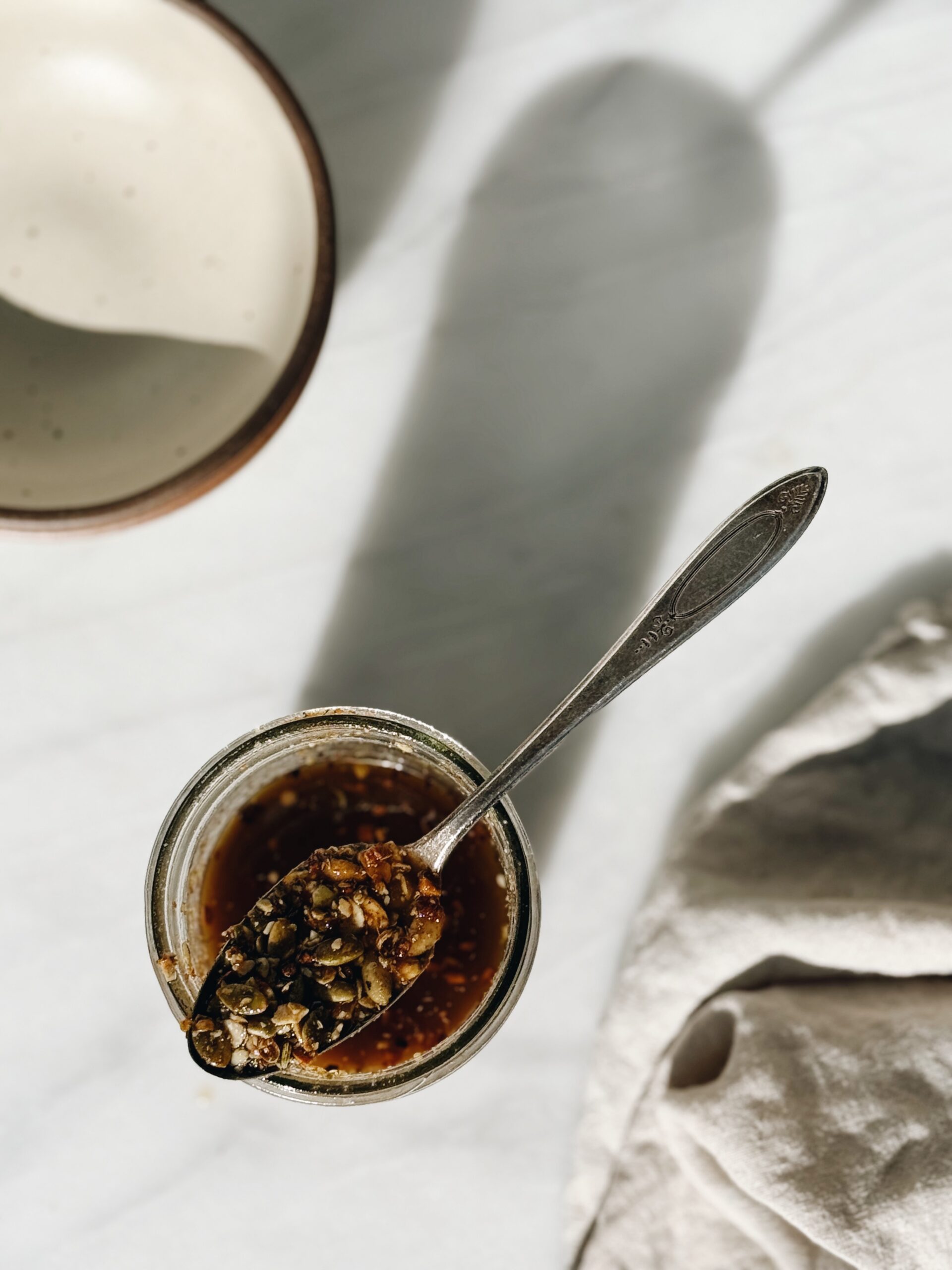
It’s easy to treat spices as flavor, and macros as the thing that actually matters. Ayurveda doesn’t split it that way, and once you start paying attention to why, the framework is hard to unsee.
Chili flake isn’t just heat for heat’s sake — it’s a direct agni stimulant, the same mechanism that makes spicy food genuinely aid digestion rather than just taste exciting. That’s a functional effect, not a flavor note. Every spice carries its own virya (heating or cooling energy) and its own effect on how food moves through you — which means two dishes with identical calorie counts can behave completely differently in the body depending on what’s seasoning them. That’s the piece nutrition-as-macros misses entirely: it treats a chili flake and a pinch of turmeric as flavor variables, not as active digestive agents.
In this recipe, the spices aren’t just decorating the dish. They’re supercharging it with flavor, nutritional value, and digesetive fire. They’re doing at least as much metabolic work as either of them, arguably more, given how small the dose is relative to the effect.
I built this to answer summer’s specific problem — heat on heat, digestion running lighter, wanting flavor without feeling cooked from the inside. But “built for summer” isn’t the same as “only good in summer,” and I don’t want to undersell it as seasonal in the limiting sense.
The reason it holds up year-round is structural: agni — your digestive fire — doesn’t just weaken in summer heat, it also weakens in winter’s cold and damp, just for a different reason. Pumpkin seeds and chili flake, sizzled in ghee, are stimulating and warming in a way that’s exactly what sluggish winter digestion wants. The dish doesn’t change; what changes is how much of it you reach for, and when. A spoonful in July is about balance. A generous spoonful in January is about building heat back up. Same jar, different job depending on the season — which is a more honest kind of “seasonless” than pretending the energetics disappear.
Crackle ghee is a huge win for Kapha. Kapha runs cool, heavy, and slow, so heat, pungency, and stimulation are the corrective — chili flake is doing exactly what kapha needs.
Vata does well too — the richness and grounding quality of ghee is a good match for vata’s tendency toward dryness and instability, and vata handles a moderate amount of heat better than you’d think.
For you pittas out there, we still need to proceed here with caution. While I’ve removed the majority of the instigators that make spicy foods a no-go for our balanced bodies, there are still a couple of things to consider here. We’re winning with the ghee, as it’s one of the only oils that doesn’t elevate pitta. But we do still have lemon, chili, and cumin all of which can elevate pitta in overabundance. Which is to say that, even if you feel like you want to put this on EVERYTHING maybe a good idea to use wisely, especially when the heat outside and inside is really kicking.
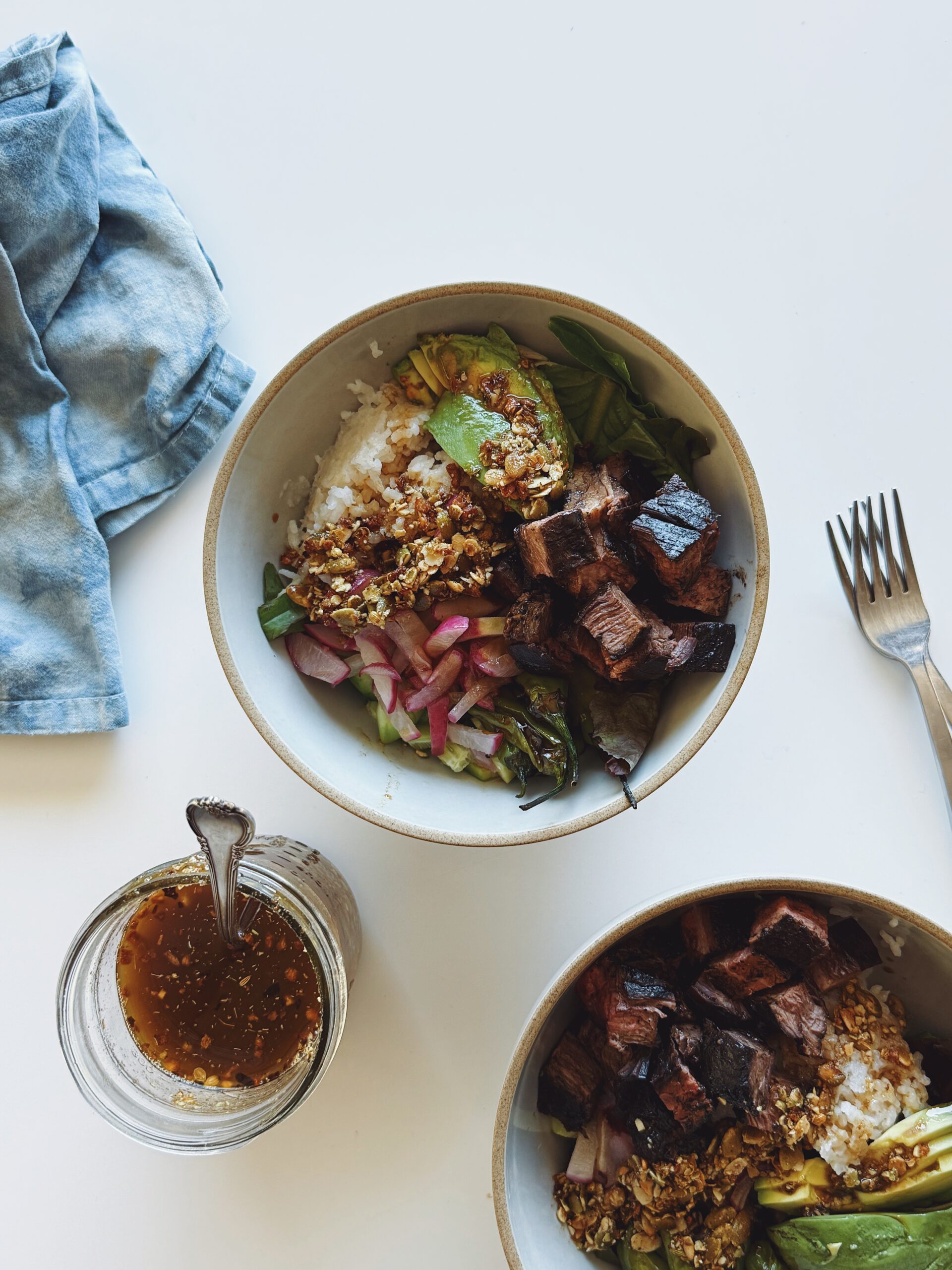
Is more than just a condiment. It’s a drizzly, crispy, crunchy “sauce” that bring warmth, nourishment and the Six Flavors to everything you eat. Ketchup cannot say that! The simplest meals are made more excellent when this crackle ghee is around, and made more complete as well.
One thing to note – your ghee won’t stay liquid forever. Ghee will become semi-solid at room temperature in your kitchen (unless your kitchen is an inferno like mine,) and so if you wish to drizzle it you’ll need to warm it a tiny bit. Know that you can also dollop crackle ghee, and it’s just as excellent!
I’m storing it on the countertop for quick zhooshings, and already on our second jar. I hope you love this one as much as I do!
That's ok, just sign up or log in to see this recipe.